Showing posts with label Junk Journals. Show all posts

Thursday, September 17, 2026

Old Paper Treasures: The Stories Hidden in Vintage Crate and Can Labels

 There is something about old paper that has always drawn me in.

Perhaps it is the faded color, the beautiful typography, or the little signs of age that remind us that a piece of paper has somehow survived while the world around it changed.

And sometimes, it is simply the surprise of discovering beautiful artwork in a place where no one really expected it to last.

Recently I came across a collection of original vintage and antique fruit crate and can labels. I began looking through them thinking I might choose just a few for Butterfly In The Attic.

That didn't quite happen.

I found butterflies and birds, fruit and flowers, old locomotives, California citrus groves, mountain landscapes—and even a mischievous apple dressed as a cowboy.

The more I looked, the more I realized these weren't simply old advertisements. They were tiny pieces of art.
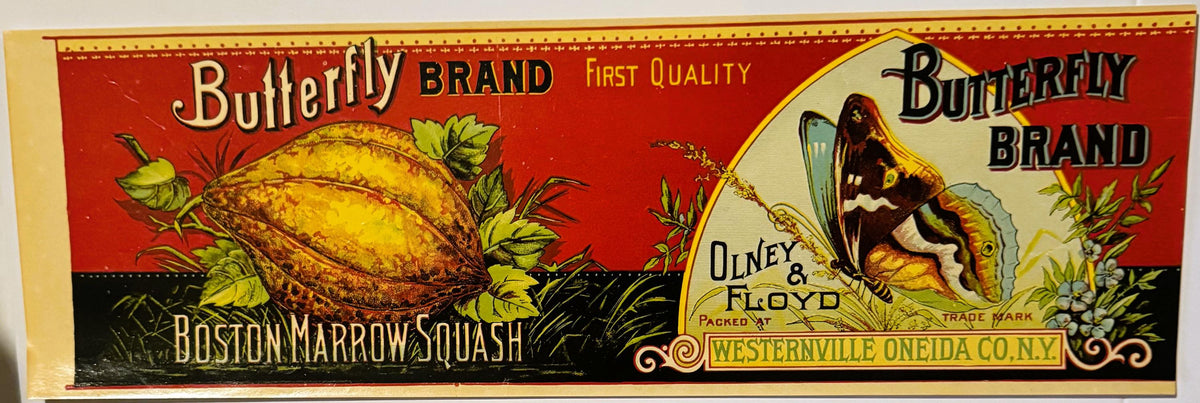
Antique 1890s Butterfly Brand Squash Can Label – Original Victorian Ephemera

A Butterfly From the 1890s

Of course, one particular label immediately caught my attention.

An original 1890s Butterfly Brand Boston Marrow Squash can label features a large butterfly surrounded by wonderfully ornate Victorian lettering and decoration.

How could something called Butterfly Brand possibly stay out of Butterfly In The Attic?

But beyond the name, I love that something created to wrap an ordinary can of vegetables more than a century ago can still be appreciated for its artwork today.

Someone designed that butterfly. Someone chose those colors and letters. Somewhere, long ago, that label was meant to catch a shopper's eye on a store shelf.

And somehow, this one survived.
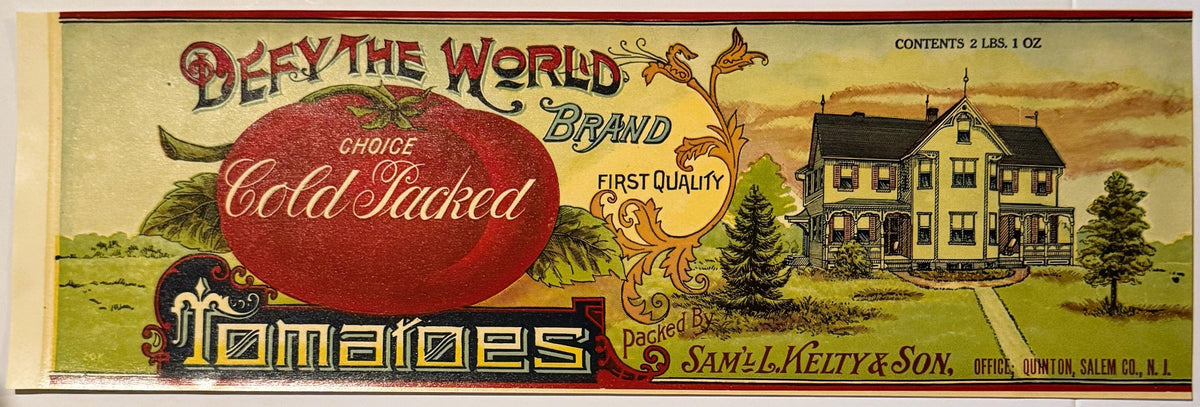
Antique 1910s–1920s Defy The World Tomato Can Label – Original Ephemera

Defy The World

Then there was the name I couldn't resist: Defy The World Tomatoes.

The original label dates to approximately the 1910s–1920s and features an enormous red tomato surrounded by elaborate lettering and a detailed farmhouse landscape.

I love the confidence of it.

Not merely Good Tomatoes. Not Excellent Tomatoes.

Defy The World.

There is something wonderfully optimistic about advertising from this period. Even a humble can of tomatoes could apparently take on the world.
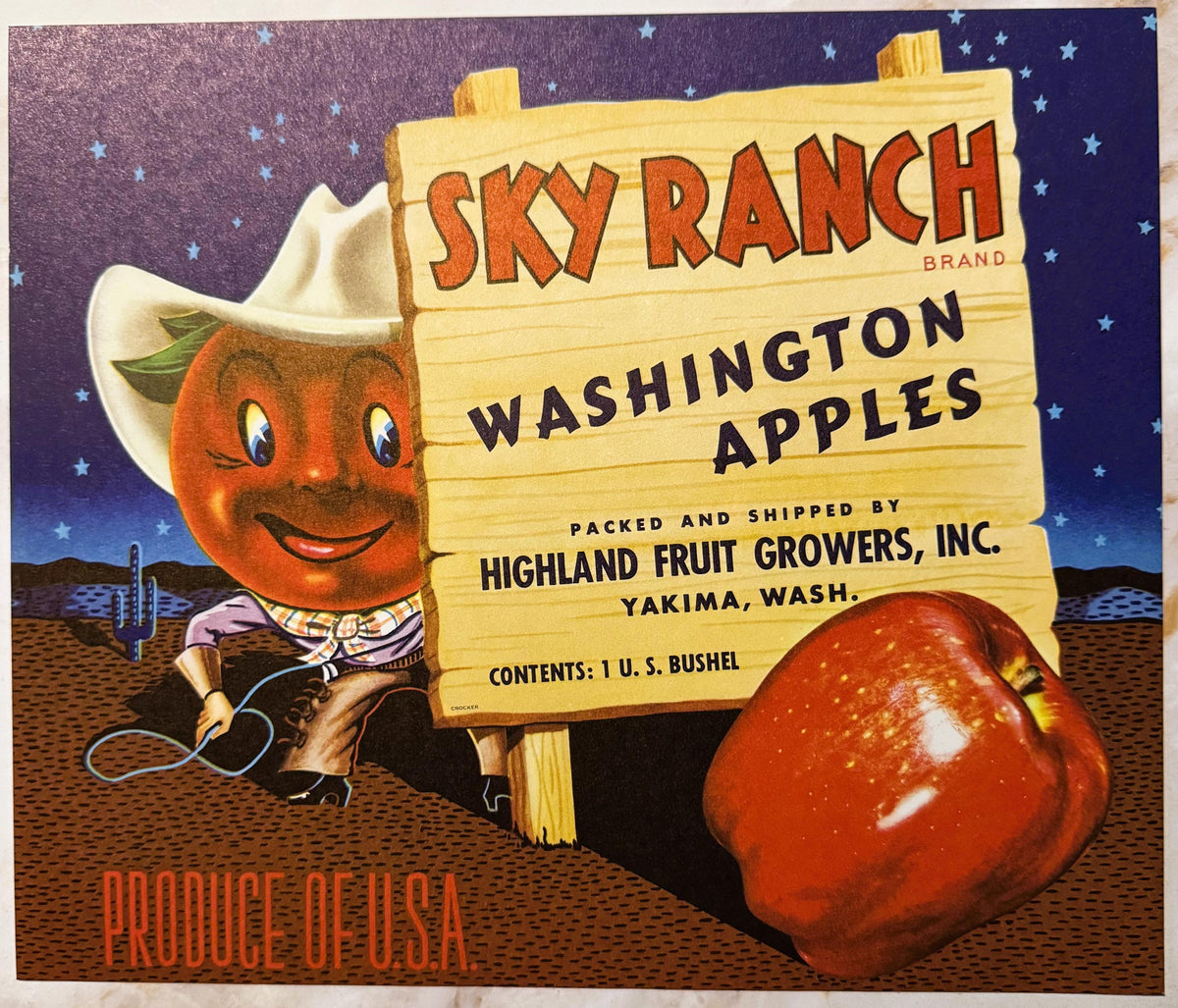
Vintage 1950s Sky Ranch Apples Crate Label – Cowboy Apple Art

An Apple With a Cowboy Hat

Not every old treasure needs to be serious.

One of my favorites is a 1950s Sky Ranch Apples crate label from Yakima, Washington.

Its star is a bright red apple dressed as a cowboy, complete with hat, boots and lasso.

It is funny, colorful and unmistakably mid-century.

It also has that wonderful sense of nostalgia I look for when choosing things for the shop—the feeling that you've opened an old drawer or box and discovered something you haven't seen since childhood.

Those are often my favorite finds.
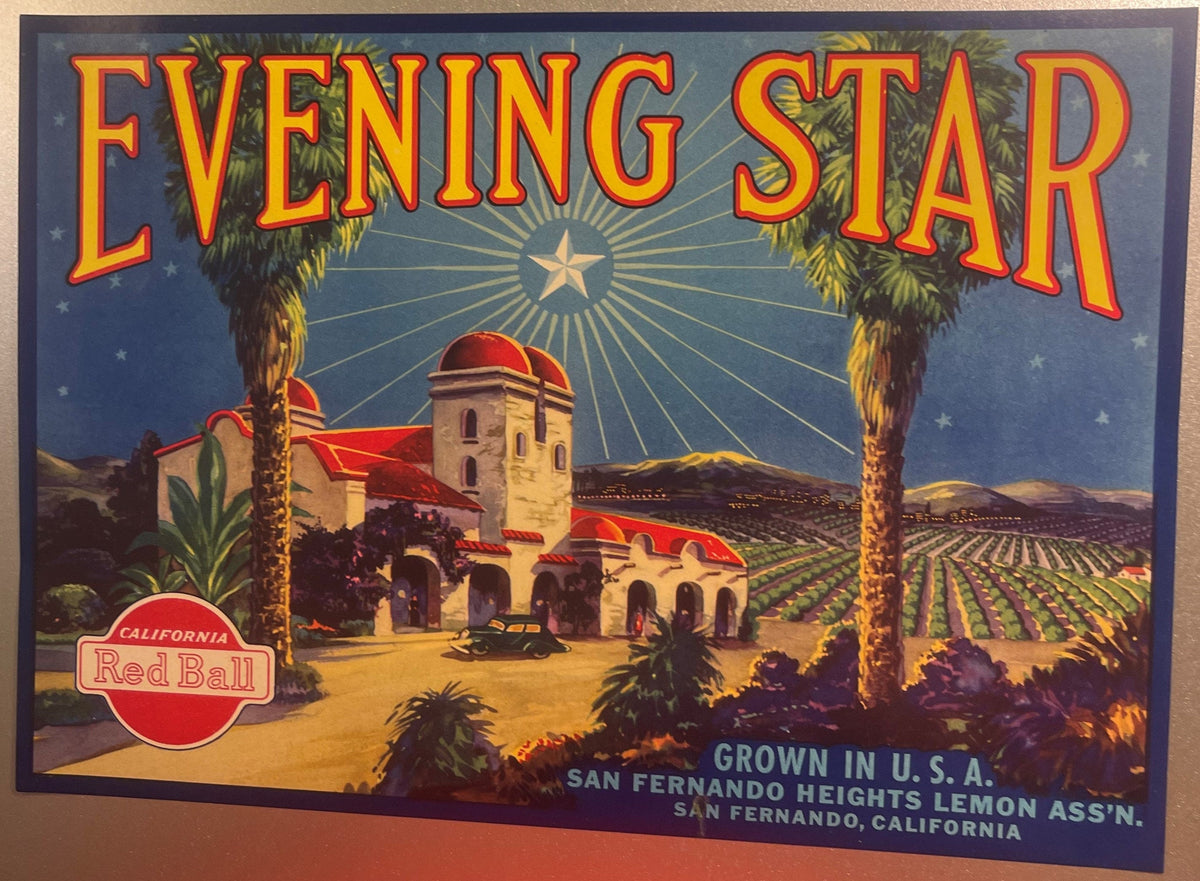
Vintage 1930s Evening Star Lemon Crate Label – California Citrus Art

California in a Piece of Paper

Some of the labels feel almost like miniature travel posters.

The 1930s Evening Star lemon crate label is one of them.

A tall palm rises over neat rows of citrus trees, with mountains in the distance and a mission-style building tucked into the landscape. The evening sky glows behind it all.

As someone who has spent so much of my life in California, I find these old agricultural labels especially fascinating.

They capture a particular vision of California—sunshine, orchards, mountains, abundance and possibility—and they preserve a little piece of the agricultural history that shaped so many communities here.

Old Paper for New Stories

What excites me most about these labels is that their stories don't necessarily have to end in a frame or collector's drawer.

For those of us who make junk journals, altered books, collage and mixed-media art, an original piece of vintage paper can become part of something new.

A large crate label might become the cover of a journal. A long can label could wrap around a handmade book, become a pocket or foldout, or be incorporated into a collage.

And because these are original vintage and antique pieces rather than reproductions, they bring something to a project that simply can't be printed from a computer: genuine age and history.

Of course, I also understand the temptation not to cut them at all.

Some treasures deserve a little time before we decide what they want to become.

Welcome to Old Paper Treasures

I've gathered my favorites into a new collection at Butterfly In The Attic called Old Paper Treasures.

I didn't want hundreds of labels simply because they were available. I chose the ones that made me stop and look—the animals, unusual characters, beautiful landscapes, wonderful typography and little pieces of history that felt as though they belonged here.

They are treasures for collectors, certainly. But I hope they'll also find their way into the hands of artists and journal makers who will give some of this old paper another chapter.

After all, that may be the loveliest thing about an old piece of paper.

Its first story has already been written. What happens to it next is up to us.

🗝️ The Hidden Drawer
What else will you find in the Hidden Drawer?

Wednesday, August 26, 2026

An Earlier Chapter: A Handmade Bird Journal in Blue & Gray

Wings in the Weathered Woods – Handmade Bird Junk Journal | Eco Printed, Rust Printed & Naturally Dyed Papers
Sometimes an older piece of work becomes a little record of where we were creatively at the time we made it.

I was thinking about that recently while looking through one of my earlier handmade junk journals—a soft, wonderfully grungy book filled with birds, blue and gray papers, botanical impressions, rust marks, and some of the techniques I was just beginning to explore.

It is very different from some of the journals I make now.

And I think that may be one of the things I like most about it.

When the Materials Begin the Story

One of my favorite things about making junk journals has always been discovering that something ordinary doesn't necessarily have to remain ordinary.

The cover of this journal began with something particularly humble: a padded Amazon packaging envelope.

I combined the packaging material with two layers of cardstock to create a cover that is softer than the covers on many of my later journals. The padded material also gives it a slightly crinkly, crunchy sound when handled—one of those tactile little details that photographs simply can't capture.

The outside was sealed for additional protection, which deepened the original brown color of the packaging and gave it an aged appearance.

An upcycled cotton ribbon wraps around the finished journal, while a simple three-hole pamphlet stitch holds the pages together.

Open bird junk journal showing aged lined paper, handmade textured pages, and layered side tabs.

Blue, Gray and the Marks Left by Nature

The colors inside became an important part of this journal's personality.

Blue and gray travel through the book alongside warm coffee-stained browns and naturally aged neutrals. Purchased bird imagery and decorative ephemera appear among the pages, helping carry that quiet palette from one section to another.

But some of my favorite pages weren't created with printed designs at all.

Several are eco-printed papers made using bougainvillea flowers. The flowers were pressed against the paper and heated, allowing the plant material to leave behind soft gray impressions and ghostlike botanical shapes.

They aren't precise botanical illustrations. Nature decided where the marks would appear and exactly what they would look like.

That unpredictability is part of their beauty.

Vintage bird junk journal page with layered bird tag, cream envelope pocket, aged paper, and mixed-media embellishments.

Other papers were dyed with blueberries and coffee, adding another layer of natural variation to the book.

There are also pages created by placing rusty objects against paper and allowing the rust to leave its own marks behind.

I love the way these processes give paper a history before a single word has been written on it.

Handmade bird junk journal open to blue and textured handmade paper pages with layered pockets and tabs.

Looking Back at Earlier Work

This was one of my earlier journals, and I can see that when I look through it now.

My work has changed. I've learned new techniques, experimented with different bindings and materials, and gradually added more of my own painted artwork to some of my newer journals.

But I don't think that makes these earlier books less meaningful.

Quite the opposite.

They show the experimenting.

The what happens if I try this?

The willingness to put a rusty object on a piece of paper just to see what kind of mark it might leave, or to discover what happens when flowers, berries, coffee, old packaging, paper, and thread all find their way into the same book.

Creative work doesn't arrive fully formed. It grows through all those experiments.

Handmade bird junk journal open to a decorated page with bird illustration, flowers, layered papers, and vintage-style details.

A Place for Another Story

The finished journal measures approximately 8½ × 5½ inches and contains 51 pages, with pockets, tucked ephemera, dyed papers, decorative pages, and quieter spaces waiting for someone else to continue the story.

Many of the removable pieces are held with paperclips that I altered to give them an aged, rusted appearance, adding another little detail to the worn and weathered feeling of the book.

The printed bird images and much of the decorative ephemera came from purchased digital designs and craft materials. I always think that distinction is important: the printed artwork isn't my original artwork. My part of the story is in selecting, altering, dyeing, assembling, layering, binding, and combining all of these different materials into one handmade book.

There is something rather appropriate about a bird journal being made this way.

Bits and pieces gathered from different places. Something discarded here, something beautiful discovered there. Natural materials leaving their marks. Little treasures collected and carried back to become part of a new home.

Perhaps junk journal makers and birds have a little more in common than I realized.

Handmade bird junk journal open to a decorated page with bird illustration, flowers, layered papers, and vintage-style details.

This particular bird journal is available in my shop, where you can also see additional photographs and the video flip-through for a closer look through its pages.

Wings in the Weathered Woods – Handmade Bird Junk Journal | Eco Printed, Rust Printed & Naturally Dyed Papers

Whether this journal eventually becomes someone's writing journal, memory keeper, collage book, or simply a handmade object to enjoy, I like knowing that an earlier chapter of my own creative journey will become the beginning of someone else's.

And perhaps that is one of the loveliest things about making books.

We finish making them—but their stories don't necessarily end with us.

Sunday, August 23, 2026

The Beautiful Things We Almost Throw Away

What Kintsugi, imperfect paper, and an old autumn journal reminded me about making things by hand.

There is a Japanese art called Kintsugi in which broken pottery is repaired with lacquer and gold. Instead of disguising the cracks, the repair draws attention to them. The history of the object becomes part of its beauty.

I have always loved that idea.

And lately, while working with hand-dyed papers and finishing an autumn junk journal, I realized how often the same idea finds its way into my own work.

Not with gold. Sometimes with coffee. Sometimes tea. Sometimes onion skins or dye. Sometimes with a piece of paper that came out of the process looking nothing like I expected.
And sometimes with an old book that has already lived a life before it ever reaches my worktable.

A Little Gold in the Cracks

Kintsugi isn't really about pretending something was never broken. That is what makes it so beautiful to me.

The break happened. The repair happened. And instead of erasing either one, the finished piece carries both.

I think handmade things can be a little like that.

When we work with natural materials, old books, vintage papers, fabric, paint and dye, we are working with things that have histories and personalities of their own. They don't always behave perfectly.
And perhaps they shouldn't.

Paper Has a Mind of Its Own

Close-up of a handmade dyed paper page with organic overlapping bubble patterns in soft hunter-green tones.
Autumn Whispers — Handmade Autumn Junk Journal

I have been doing a great deal of paper dyeing lately, and one thing becomes obvious very quickly: paper has a mind of its own.

Coffee settles differently from one sheet to another. Tea leaves soft variations. Onion skins can create unexpected marks and impressions. Dye travels into fibers in ways I couldn't reproduce exactly even if I tried.

Sometimes a stencil leaves a beautiful pattern. Sometimes the paper picks up the texture of something it rested against. Sometimes the most interesting part of the sheet is something I never intended to happen at all.

I could look at those variations as flaws. Instead, I think they are evidence.
Evidence that a person made the paper. Evidence that water moved across it, dye settled into it, bubbles rested and burst against it, and the materials were allowed to participate in the outcome.
No two sheets are quite the same because the process itself is alive with variables.

Then There Was the Old Book

That idea became especially meaningful while I was making my large autumn junk journal.

Editorial rendering closely representing a handmade autumn junk journal with a vintage book cover, brown fabric tie, layered textiles and golden fall leaf embellishments.
Rendered editorial image created to closely represent my handmade Autumn Junk Journal. For photographs of the actual journal and its individual details, please see the product listing
Autumn Whispers — Handmade Autumn Junk Journal

The journal began with an old vintage book.

I kept portions of the original book, including the first two and last two pages, and built the new journal around the life that was already there.

Inside are 90 pages filled with layers of old and new: naturally dyed coffee and tea papers, onion-skin patterned paper, richly dyed cranberry and dark green pages, printed digitals, handmade embellishments, watercolor paintings, painted journal cards and tags, hand-painted leaves and other little details gathered together into one very full book.

Some of those pages are wonderfully unpredictable.
Handmade autumn junk journal opened to an original watercolor painting of a golden fall pathway lined with black lampposts and colorful autumn trees, tucked into a decorative corner pocket.
Autumn Whispers — Handmade Autumn Junk Journal
There are six watercolor paintings tucked among the pages, along with other painted pieces and handmade elements. They aren't there simply to decorate the book. They help make turning the pages feel a little like wandering.

You never quite know what the next page will hold.

There Is a Difference Between Carelessness and Imperfection

This distinction matters to me.

Handmade should not mean careless.

I want the things I make to be thoughtfully constructed. I care about the materials, the details and how everything comes together.

But thoughtful handmade work does not have to mean machine-perfect work.
One of the pages in this journal illustrates that beautifully.

Layered page inside a handmade autumn junk journal showing vintage book text, delicate die-cut paper, frayed fabric and a naturally imperfect lower corner created during the dyeing process.
Autumn Whispers — Handmade Autumn Junk Journal
A few pages were affected during dyeing. Two have corners that are missing or rounded, and another has a more jagged edge.

I considered leaving them out.

But the more I looked at them, the more I realized those imperfect edges brought something to the journal that a perfectly cut page couldn't.

They added to the rustic charm I was trying to capture—the feeling of something that has been kept, handled and loved. They reminded me of the things we rediscover from autumns past: an old book with softened corners, a well-worn recipe, a pressed leaf tucked between pages, or some small treasure saved because of the memories attached to it.

Suddenly, those imperfect corners didn't feel like something I needed to remove. They helped create the sense of nostalgia I wanted this journal to hold.

So they stayed.

Not hidden. Not apologized for. Simply allowed to become part of the story.

Maybe the Evidence Is Part of the Story

The cranberry-dyed pages are another example.
Rich cranberry-colored hand-dyed journal page with an organic botanical-style pattern and natural variations in the dye
Autumn Whispers — Handmade Autumn Junk Journal
The color moves across the paper. The pattern isn't mechanically uniform. There are darker areas and lighter ones.

Those variations tell you how the page was made.

And then there is one of my favorites—the onion-skin paper.
Handmade autumn journal page naturally dyed with onion skins, showing soft golden organic impressions alongside a folded cream paper rosette.
Autumn Whispers — Handmade Autumn Junk Journal
For this paper, I actually left the onion skins against the sheet so they could make their own impressions.

The result isn't a printed pattern pretending to be natural. It is natural.

The marks came from the material itself.

That seems like such a small distinction, but I think it is part of what makes handmade work feel different when you hold it.

You can see the process. Sometimes you can almost reconstruct what happened at the worktable simply by looking closely enough.

And maybe that is why Kintsugi has been on my mind.

We spend so much time being taught to remove evidence.

Hide the crack. Trim away the uneven edge. Discard the page that behaved differently. Start over until no one can tell that human hands were ever involved.

But what if some of that evidence is exactly what gives an object its character?

What if the unexpected stain, softened corner, uneven edge or old book page isn't something standing between us and the finished piece?

What if it is part of the finished piece?

I don't think that means everything imperfect is automatically beautiful. But I do think there are beautiful things we almost throw away because we are looking at them only for what went wrong instead of noticing what happened.

And sometimes what happened is much more interesting.

So I am going to keep making room for those pages. For the old books. For the strange marks. For the edges that tell on themselves. For the materials that refuse to behave exactly the same way twice.
Kintsugi may use gold to honor the history of an object.

Around here, sometimes all it takes is deciding that the history was worth keeping.

Until next time,
Colleen
Butterfly in the Attic